
The IDE in the Age of Autonomous Development Agents – Market Analysis March 2026
The use of a classic IDE – whether VS Code, Cursor, Windsurf or JetBrains – is being fundamentally called into question by a growing number of teams. SDD/TDD frameworks such as Superpowers, BMAD or GSD are increasingly finding their way into established companies and product developments. Is the end of the IDE as we know it foreseeable? An in-depth market analysis.
1. The Current Market Situation: Numbers That Surprise
Let’s begin with what surveys actually show – and what they do not show.
Traditional IDEs are holding their ground – for now. According to the Stack Overflow Developer Survey 2025, Visual Studio Code and Visual Studio continue to take the top spots among developers – for the fourth year in a row. However, the use of AI-enabled IDEs is growing significantly: Cursor reaches 18%, Claude Code 10%, Windsurf 5%.
VS Code recorded a usage rate of 75.9% in 2025 – a slight increase over the previous year. The editor thus remains clearly dominant, while AI-native alternatives grow but do not yet displace traditional IDEs.
The IDE market is growing – nonetheless. The global IDE market was valued at 2.43 billion USD in 2023 and is projected to grow to 4.05 billion USD by 2032 – at a CAGR of 5.83%. This sounds counter-intuitive at first to the thesis of the death of the IDE.
But beneath the surface, the tectonics are shifting massively.
2. The Real Change: From Editor to Agent
The crucial insight is not “IDE vs. no IDE”, but a fundamental shift in the interaction layer.
The distinction is precise: an AI-native IDE (Cursor, Windsurf, Zed) lives within the editor, accelerates the workflow and handles multi-file edits through a visual interface – the developer stays at the wheel. An agentic tool (Claude Code, GitHub Copilot CLI) operates at the codebase level: you set a goal, and it plans, writes, tests and iterates with minimal human intervention.
The biggest shift in 2026 is the movement away from IDE plugins towards terminal-native agents. This is not just a UX preference: terminal agents compose with existing tools – pipes, scripts, CI systems – in a way that IDE plugins cannot. They adapt to how experienced developers already work, rather than asking developers to change the way they work.
“The IDE will no longer be the centre of the developer universe. AI-powered editors like Cursor and Windsurf are a stop on the AI journey, not the destination. The future is the conversation with an agent.” — Coder Blog, July 2025
3. Claude Code as a Case Study: The Meteorite Impact
No single example illustrates the change better than the rise of Claude Code.
Since its release in May 2025, Claude Code has become the most widely used AI coding tool among respondents to the Pragmatic Engineer Survey – overtaking GitHub Copilot and Cursor. 95% of respondents use AI tools at least weekly, 75% use AI for more than half of their work, and 56% accomplish 70%+ of their engineering work with AI support.
Claude Code is the most loved tool, with a 46% positive rating – far ahead of Cursor at 19% and GitHub Copilot at 9%. A common way of working in the survey is the split-screen setup: a terminal with Claude Code for the actual work, and an IDE alongside it to review the changes made.
This is telling: the IDE becomes the review layer, no longer the main working environment.
4. SDD/BMAD Frameworks: The Structural Context
According to Thoughtworks, SDD is one of the most important engineering practices of recent years – the rigour of specification-based development combined with the adaptability of agentic AI workflows. The BMAD Method is regarded as the most complete SDD framework, with 21 specialised AI agents, over 50 guided workflows and an intelligence adaptable to project size.
GitHub Spec Kit reached 72,700 GitHub stars and 110 releases by February 2026, with support for 22+ AI agent platforms including Claude Code, GitHub Copilot, Amazon Q Developer CLI and Gemini CLI.
McKinsey’s Technology Trends Outlook 2025 highlights generative AI and shows that organisations achieve 20–45% productivity gains in development workflows through AI tools.
Another signal: AWS Builder (July 2025) emphasised that the industry is moving from prompt engineering towards specification-based approaches – because prompt engineering fundamentally cannot solve structural context-management problems.
5. The Critical Counter-Thesis: Not All That Glitters
An honest analysis also requires criticism. Not all voices see SDD as a universal solution.
SDD produces a lot of text, especially in the design phase. Developers spend a considerable part of their time reading and reviewing long Markdown files. In addition: SDD shines when starting new projects, but as the application grows, specs more often miss the point and slow down development. For large existing codebases, SDD is mostly unusable.
Another blind spot: BMAD runs into the same wall as Domain-Driven Design. If an organisation cannot implement DDD properly, it will not benefit from BMAD’s specification layer either. The specification layer depends entirely on the quality of the domain knowledge that the human brings in. The agent cannot invent domain expertise that is not in the room.
SDD frameworks are no silver-bullet substitute for missing domain expertise.
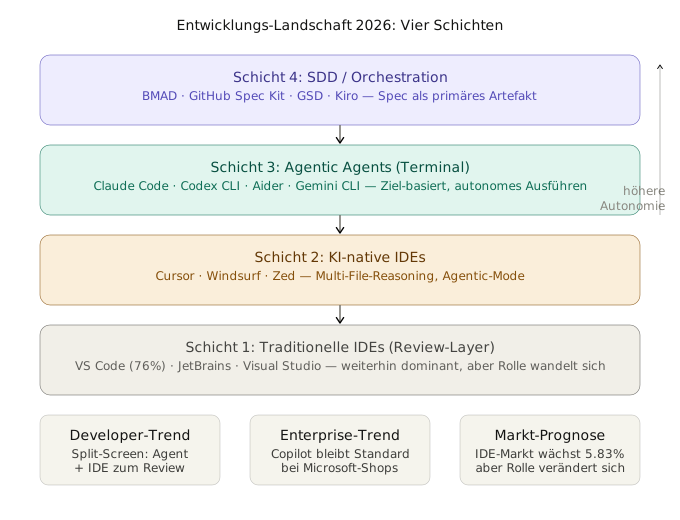
6. Market Structure 2026: The Four-Layer Model
The reality is more nuanced than “IDE dead or alive”. A four-layer model is more apt:
7. Will the IDE Still Exist at the End of 2026? – The Nuanced Verdict
Position A – “The IDE is dying”
This position has strong arguments. The shift towards agentic code development happened quickly: in 2023, developers wanted smarter code suggestions. In 2026 they hand entire features over to AI agents that can read a codebase, write and test code, interpret errors and iterate without constant guidance. Most highly productive developers today use two tools: an agentic tool for the heavy lifting – and the IDE still for review.
Position B – “The IDE is transforming”
What sets developers apart in 2026 is not which editor they use, but how well they deploy AI within that editor. The most valuable skill in 2026 is the art of communicating, revising and collaborating with LLMs.
Position C – “Declared dead, but structurally stable”
Traditional IDEs are not being replaced by AI-powered alternatives. VS Code and Visual Studio held their top positions for the fourth consecutive year. These numbers, however, underestimate the change, because they measure overall usage – not “primary working environment”.
8. Who Is Really Leaving the IDE?
Not all segments are moving at the same pace. This reveals the real pattern:
- Startups, agencies, innovative product teams → are actively leaving IDE-centric working behind
- Large enterprises, regulated industries → move more slowly; Copilot dominates for procurement reasons
- Solo developers and technology pioneers → are already in the terminal-agent paradigm
Smaller companies overwhelmingly prefer Claude Code (75% at the smallest businesses), while large corporations default to GitHub Copilot – primarily due to enterprise procurement processes and Microsoft’s enterprise marketing.
Conclusion
The question “Will the IDE still exist at the end of 2026?” can be answered as follows: Yes – but its role has fundamentally changed. From the main working environment to the control layer. The four-layer model describes the current state more precisely than any black-and-white thesis.
The change is real and fast – but it unfolds in a segmented way. Whoever actively shapes it today defines how software will be built tomorrow.
Market analysis based on the Stack Overflow Developer Survey 2025, the Pragmatic Engineer AI Tooling Survey 2026, the JetBrains Developer Ecosystem Report 2025, the DataCamp Agentic IDE Report 2026 as well as sources from Faros AI, ToolShelf, Augment Code and others.